Colouring your hair naturally with plant colouring 100%
A plant colouring is a natural hair colouring without harmful chemicals such as p-Phenylenediamine (PPD), ammonia, parabens, resorcinol, peroxide, etc. The colouring consists entirely of different plants and herbs and is enriched with natural medicinal ingredients recognised by Ayurveda
A traditional hair colour with chemicals opens the hair cuticles and (semi) permanently changes the hair colour inside. This can damage the hair, whereas plant colouring actually nourishes and protects your hair every time.
When using a plant colouring, the hair's natural colour pigments and structure are not affected, but rather a layer is placed around your hair with each treatment. This protective layer thickens and your hair becomes stronger and shinier. Combining your own hair colour with the use of a plant colouring creates vibrant, natural colour shades.
A plant colouring does not penetrate the hair structure like a traditional "chemical" hair dye. Due to its mild and caring properties, plant colouring is very suitable for people with sensitive skin and prevents irritation of the scalp. Plant colouring can even be used safely during pregnancy and while breastfeeding.
Features 100% natural plant colouring
- No harmful substances on or in your body.
- Prevents damage to hair and skin.
- No allergic reactions to PPD. (or substitutes thereof)
- For more vital hair and reduces hair loss. (Provided it is not caused by hormonal/medical reasons)
- Also covers white/grey hair.
- Safe during pregnancy.
- Restores and improves the structure and condition of your hair.
- Plant-based colouring is individual and looks natural because it mixes with your own hair colour. This also means that the natural darker and lighter nuances are preserved. This gives you a natural way for hair with high- & low- lights effect.
- Prevents dandruff.
- Protects against UV radiation.
Disadvantages traditional "chemical" hair dye
The harmful chemical components of traditional chemical colouring affect hair quality. You often see hair becoming dry, damaged, frizzy, less full and shiny. The chemicals also re-enter our planet and also our skin. With a 100% plant colouring, this is fortunately not the case, while you can still colour your hair (including grey) permanently.
Disadvantages of plant colouring
- It is not possible to lighten your hair, but there are more than enough other options so that you get your own unique hair colour that suits you well.
- In one colouring from light to (very) dark is difficult. This always requires double colour coverage. This takes time and is therefore a bit pricier.
- Grey hair will always remain slightly lighter than non-grey hair.
Most people actually like this because the end result is more subtle and looks less harsh than chemical hair dye. If you are used to using chemical dyes, you may have to get used to the more subtle colour result achieved with 100% natural hair colouring at first. - If your hair is more than 20% grey and you want more intense grey coverage, it may be necessary to pre-pigment the hair. This always requires double the colour coverage. This takes time and is therefore a bit pricier.
- It is no longer possible to blonde hair that has been coloured with plant colouring.
- Should you eventually want to switch back to chemical hair colouring, this is possible provided it is dyed at the same colour level and done in a gentle manner.
Are you as enthusiastic as I am? Then switch too, you definitely won't regret it! ?
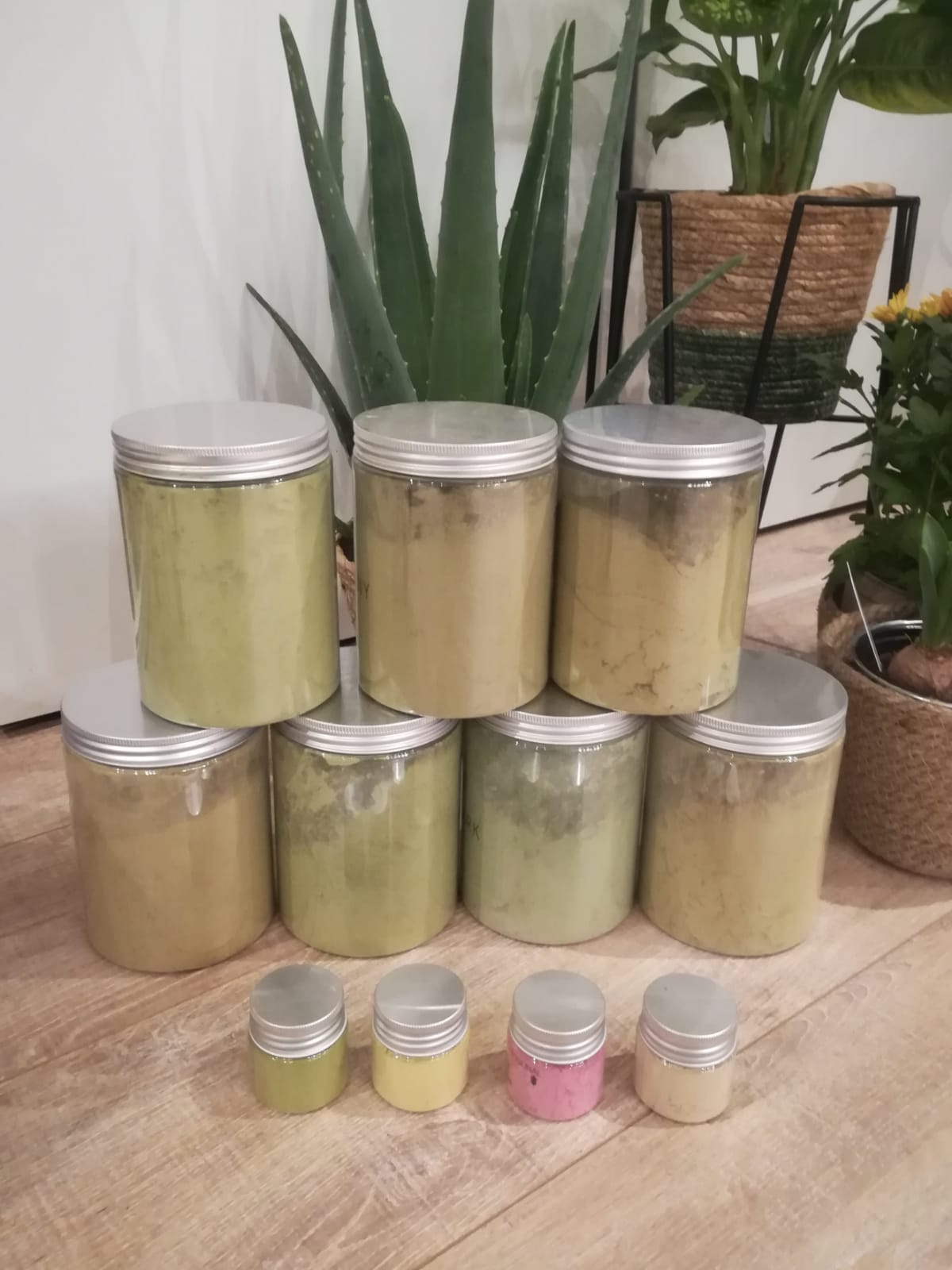
Plant colours are made with the dried and ground ingredients listed below, among others:
- Lawsonia inermis (Henna) Leaf Powder*: Red henna for shelf life of plant colouring, puts a protective and strengthening layer around the hair for full and shiny hair. Has cleansing, antibacterial and anti-fungal properties and functions as a natural sunblock.
- Indigofera tinctoria (Indigo) Leaf Powder*: Dark-coloured leaf powder. Has antibacterial and antiviral activity. Without p-phenylenediamine (PPD) Makes colouring darker and gives neutral and cool colour reflections.
- Emblica officinalis (Amla) Fruit Powder*: Indian gooseberry, full of vitamin C and antioxidants.
- Ziziphus spina-Christi (Ziziphus) Leaf Powder*: Christthorn, colourless leaf powder for shine and strength fine hair, fixative in Indigo and softens colour intensity of colour powders
Rich in minerals, cleansing, conditioning, strengthening, soothing for the scalp. - Cassia auriculata (Cassia cinnamon) Leaf Powder*: For lighter plant colours. Places a protective layer around your hair, strengthens, makes hair fuller/thicker and gives lots of shine. Helps against irritated scalp and dandruff.
- Eucalyptus globulus (Eucalyptus) Leaf Powder*: Strengthens hair, stimulates hair growth, anti-bacterial, gives lots of shine.
- Aloe barbadensis (Aloe Vera) Leaf Powder*: Works moisturising, emollient, nice soft emulsifier
- Curcuma longa (Turmeric) Rhizome Powder*: Soft yellow colouring and supports the healing ability of hair and scalp (anti-inflammatory)
- Matricaria recutita (Chamomile) Flower Powder*: Works soothing, anti septic, gives a blonde sheen.
- Hibiscus sabdariffa (Hibiscus) Flower Powder*: Soft red dye, contains many antioxidants.
- Beta vulgaris (Beet) Root Powder*: Soft red beetroot dye full of minerals and antioxidants.
- Rubia cordifolia (Indian madder) Root Powder*: Soft red dye, purifies and nourishes scalp100% of the ingredients are organic and from organic farming.
*COSMOS ORGANIC certified by Ecocert Greenlife according to the COSMOS standard.
Rates 100% natural plant colouring
See all prices here: https://afspraken.denatuurlijkekapper.nl/