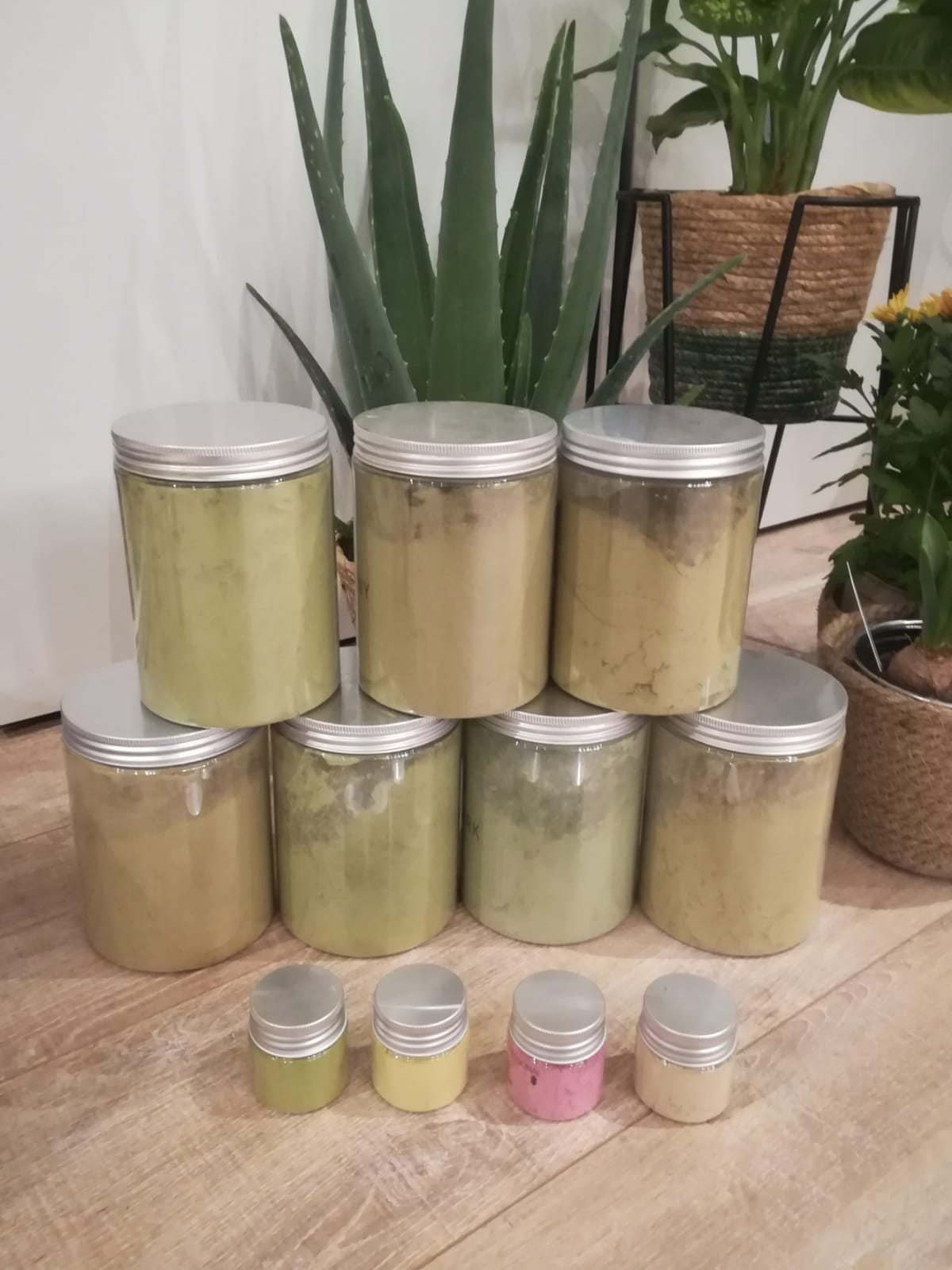
Colouring your hair naturally with plant colouring 100%
A plant colouring is a natural hair colouring without ingredients such as p-Phenylenediamine (PPD), ammonia, parabens, resorcinol and peroxide. The colouring consists of various plants and herbs and is enriched with ingredients traditionally used within Ayurveda.
With a traditional hair dye, the hair cuticles are opened and the hair colour is (semi) permanently changed inside. This can damage the hair. With plant colouring, the hair is coloured in a gentler way and cared for at the same time.
When using a plant colouring, the hair's natural colour pigments and structure are not affected. Instead, the colouring puts a caring layer around the hair with each treatment. This can leave hair feeling fuller and with more shine. Combining your own hair colour with a plant colouring creates vibrant and natural colour nuances.
A plant colouring does not penetrate the hair structure in the same way as traditional hair dye. Because of its mild properties, a plant colouring is often suitable for people with sensitive scalps and can help keep the scalp comfortable. Many people also choose a plant colouring during pregnancy or breastfeeding because it does not contain harsh chemicals.
Features 100% natural plant colouring
- Contains no PPD, ammonia or peroxide.
- Gentle way of colouring that cares for the hair.
- Suitable for people with sensitive scalps.
- Can add shine and volume to hair.
- Also covers white or grey hair.
- Gives a natural colour result with subtle nuances.
- The colour forms in combination with your own hair colour.
- Helps leave hair feeling supple and cared for.
Disadvantages traditional "chemical" hair dye
Traditional hair dyes may contain ingredients that intensely alter the hair. This can cause hair to become drier or more fragile over time. In addition, some ingredients can be less friendly to skin and the environment.
Disadvantages of plant colouring
- It is not possible to lighten the hair.
- A transition from light to very dark may require several colourings.
- Grey hair often stays slightly lighter than the rest of the hair.
- For more than about 20% of grey hair, pre-pigmentation may be required.
- Hair coloured with plant colouring is harder to bleach later.
- Switching to chemical colouring remains possible, provided it is done mildly.
Are you as enthusiastic as I am? Then make the switch too and discover the benefits of natural hair colouring.
Plant colours are made with the dried and ground ingredients listed below, among others:
- Lawsonia inermis (Henna) Leaf Powder*: provides colour and creates a protective layer around the hair.
- Indigofera tinctoria (Indigo) Leaf Powder*: gives darker shades and cool colour reflections.
- Emblica officinalis (Amla) Fruit Powder*: rich in antioxidants and nurturing properties.
- Ziziphus spina-Christi Leaf Powder*: supports shine and hair structure.
- Cassia auriculata Leaf Powder*: adds shine and volume to hair.
- Eucalyptus globulus Leaf Powder
- Aloe barbadensis Leaf Powder
- Curcuma longa Rhizome Powder
- Matricaria recutita Flower Powder
- Hibiscus sabdariffa Flower Powder
- Beta vulgaris Root Powder
- Rubia cordifolia Root Powder
100% of the ingredients are from organic farming.
*COSMOS ORGANIC certified by Ecocert Greenlife according to the COSMOS standard.
Rates 100% natural plant colouring
See all prices here:
https://afspraken.denatuurlijkekapper.nl/